What Is AES-256 Encryption? ("Military-Grade," Explained)
The global standard for data security—and what that 256-bit key really means.
By Himanshu Bhatt· 5 min read· August 9, 2026
- AES (Advanced Encryption Standard) is a global standard for scrambling data, set by the US NIST.
- The "256" is the key length in bits — the number of possible keys is astronomically large.
- It's a symmetric cipher: the same secret key both locks and unlocks the data.
- Brute-forcing an AES-256 key is considered computationally infeasible with today's technology.
- "Military-grade" is marketing shorthand: AES-256 is approved for classified data, but real security also depends on correct implementation.
On this page(show)(close)
AES-256 is a specific, widely trusted way of encrypting data — turning readable information into scrambled ciphertext that only someone with the correct key can unlock. "AES" stands for Advanced Encryption Standard, adopted by the US National Institute of Standards and Technology (NIST), and "256" refers to the length of the secret key in bits. It's the encryption sitting behind almost every "military-grade" or "bank-grade" claim you'll see in VPN marketing.
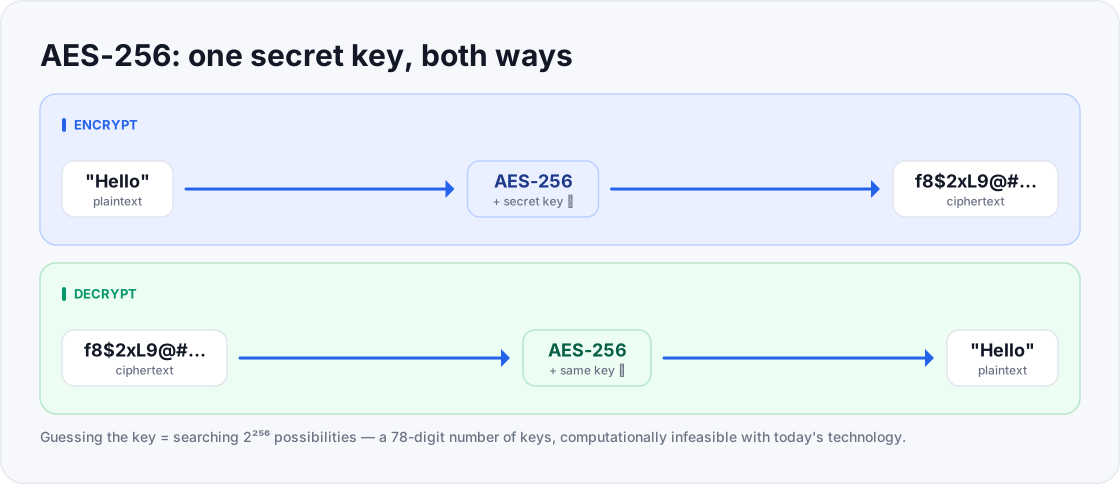
The simplest way to picture it: AES-256 is a lock, and the key is a specific secret code. Put your data in the box, lock it with the key, and it becomes meaningless scrambled text to anyone without that exact key. AES is a symmetric cipher, which means the same key both locks and unlocks the data — so the real challenge isn't the lock's strength (it's excellent), it's making sure only the right people ever hold the key.
What the "256" actually means
The number is the size of the secret key, measured in bits. A 256-bit key has 2²⁵⁶ possible values — written out, that's a number with 78 digits. Trying every possible key one by one ("brute force") means working through that unimaginable range, which is considered infeasible for any computer that exists today. Each extra bit doubles the number of possible keys, which is why 256-bit is the high-assurance choice over a still-strong 128-bit key: the safety margin is exponentially larger.
Why brute force doesn't work — and the honest nuance
It's tempting to call AES-256 "unbreakable," but the accurate phrasing is computationally infeasible to brute-force: there's no known practical way to try enough keys to crack it in any meaningful timeframe. That's a stronger, more honest claim than "impossible." In the real world, attackers almost never attack the cipher itself — they go after the weak points around it: stolen keys, sloppy implementation, leaks, or tricking a person into handing over access. The math holds up; the mistakes are human.
Why it's called "military-grade"
AES is a public, standardized algorithm — anyone can inspect exactly how it works, which is a strength, not a weakness (its security comes from the key, not from secrecy). In fact, AES is the first and only publicly available cipher the US National Security Agency (NSA) has approved to protect information classified up to TOP SECRET, when it's used inside an NSA-approved cryptographic module — and that approval is the basis for the "military-grade" label. The phrase is marketing, but it isn't baseless: the same core algorithm secures everything from government secrets to online banking to the messages on your phone.
Where AES-256 fits inside a VPN
In a VPN, AES-256 (or the equally strong ChaCha20 used by some modern setups) is the cipher that actually scrambles your data as it moves through the encrypted tunnel. But it's just one ingredient in the whole system: the protocol (like WireGuard or OpenVPN), the way keys are exchanged, and the correctness of the implementation all matter just as much. Strong encryption that's poorly implemented is still weak — which is exactly why independent audits and a reputable provider tell you more than a single acronym on a features list. A helpful way to picture it: AES-256 is the strong steel of the vault door, but a vault is only as safe as its hinges, its walls, and who's trusted with the combination. That's why two products can both advertise "AES-256" and still differ enormously in real-world safety — the cipher is identical, but everything built around it is not.
AES-256 vs AES-128 vs ChaCha20
| AES-128 | AES-256 | ChaCha20 | |
|---|---|---|---|
| Key length | 128-bit | 256-bit | 256-bit |
| Strength | Strong | Stronger (bigger margin) | Comparably strong |
| Typical use | Fast, everyday encryption | High-assurance / "military-grade" | Modern setups, fast on phones |
| Verdict | Secure | Secure, higher margin | Secure, mobile-friendly |
Quick glossary
- AES — Advanced Encryption Standard, a global standard cipher set by NIST.
- Cipher — the algorithm that scrambles (and unscrambles) data.
- Key — the secret code that locks and unlocks the data.
- Bit — a single 1-or-0; a 256-bit key is a 256-long string of them.
- Symmetric encryption — the same key both encrypts and decrypts, which is how AES works.
- Brute force — trying every possible key until one works; infeasible for AES-256.
- Ciphertext / plaintext — the scrambled data versus the readable original.
- ChaCha20 — a modern cipher, comparably strong to AES-256 and fast on mobile.
- Key exchange — how two parties safely agree on the shared key without exposing it.
Frequently asked questions
- Is AES-256 unbreakable?
- No encryption is "unbreakable" in principle, but brute-forcing an AES-256 key is considered computationally infeasible with current technology. Real-world attacks target implementation flaws, not the cipher itself.
- Is AES-256 better than AES-128?
- It has a longer key and a larger safety margin. Both are strong; 256-bit is simply the higher-assurance choice.
- Is ChaCha20 worse than AES-256?
- No — ChaCha20 is a modern, comparably strong cipher, and often faster on phones. Both are considered secure.
- Does "military-grade" mean the VPN is safe?
- Not by itself. It tells you the cipher is strong, but overall safety depends on the protocol, key handling, leak protection, and the provider's integrity.
- Will quantum computers break AES-256?
- AES-256 is generally considered more resilient to foreseeable quantum attacks than smaller keys, but this is an evolving research area — treat sweeping claims with caution.
- Where is my AES-256 key actually stored?
- In a VPN, the keys are generated and handled by the app during the connection, not typed in by you. The security of the whole system depends on those keys being created and stored properly — another reason implementation quality matters.
- Is "bank-grade" encryption different from "military-grade"?
- Not really — both are marketing phrases that usually point at the same standard, AES. The label tells you the cipher is strong; it says nothing about the rest of the product.
- Does a longer key make encryption noticeably slower?
- Slightly, because there's a little more work to do, but on modern devices the difference is negligible — many processors even have built-in AES acceleration. You won't feel AES-256 versus AES-128 in everyday use.
- If AES is public, why can't attackers just reverse it?
- Because its security comes from the secret key, not from hiding the method. Knowing exactly how the lock works doesn't help you open it without the key — and there are astronomically too many keys to guess.
Where to go next
Encryption only sender & receiver can read
Where AES fits in truly private messaging.
VPNs that get the whole stack right
Strong ciphers, correctly implemented.
This article was produced with AI assistance for drafting/research. All facts have been verified and the final content has been reviewed and approved by a human editor.
Test Your Knowledge
Enjoying this guide?
TechToolsHQ is an independent, reader-supported tech platform. If this article saved you time, solved a tough problem, or helped you learn a new skill, consider supporting our work. Your support helps us keep our in-depth series 100% free and updated for everyone.
Don't miss the next deep-dive
Weekly breakdowns of the tools students and builders actually use.
No spam·Unsubscribe any time·Privacy-first