
Skip to content
TechToolsHQ
NewsReviewsGuidesTech 101Tech SeriesToolsNewsletter
TechToolsHQ

Independent, research-driven tech coverage — breaking news, in-depth reviews, buying guides, and technical tutorials to help you understand and choose with confidence.

Explore
NewsReviewsGuidesTech 101Tech SeriesFree Tools
Legal
About UsOur AuthorsContact UsPrivacy PolicyTerms of ServiceCopyright & DMCAAffiliate DisclosureEditorial PolicyAdvertise With Us

© 2026 TechToolsHQ. All rights reserved.

Tech Series/Database Management System/Participation Constraints in DBMS: Total vs Partial
Database Management System · Part 4 of 4

Participation Constraints in DBMS: Total vs Partial

Must an entity take part in a relationship, or not? That’s the participation constraint.

By Himanshu Bhatt· 2 min read· October 1, 2026

Participation Constraints in DBMS — article hero.
Key Takeaways · TL;DR
  • A participation constraint is the minimum number of relationship instances an entity must take part in.
  • Total participation: every entity in the set must take part in at least one relationship (minimum cardinality 1; double line).
  • Partial participation: an entity may or may not take part (minimum cardinality 0; single line).
  • Participation is set by the MINIMUM cardinality — minimum 0 means partial, minimum 1 means total.
  • The MAXIMUM cardinality (1 or N) sets the cardinality ratio from Part 3, not the participation.
  • The same relationship can be total on one side and partial on the other (Department total, Employee partial in “manages”).
☰ On this page(show)(close)
  • 1.What is a participation constraint?
  • 2.Total participation
  • 3.Partial participation
  • 4.One relationship, two participations
  • 5.Participation and cardinality
On this page
  • 1.What is a participation constraint?
  • 2.Total participation
  • 3.Partial participation
  • 4.One relationship, two participations
  • 5.Participation and cardinality
INFO

Part 4 of the Database Management System series. Part 3 covered cardinality — how many entities can be linked. This part covers the other half of the rule: participation — whether an entity must be linked at all.

What is a participation constraint?

A participation constraint defines the minimum number of relationship instances an entity must take part in. Where cardinality asks “how many can an entity be related to?”, participation asks a simpler question: “does the entity have to be related at all?” There are two possible answers — it must, or it may.

Those two answers are the two types of participation constraint:

  • Total participation — the entity must take part
  • Partial participation — the entity may or may not take part

Total participation

In total participation, every entity in the entity set must take part in at least one relationship instance — there are no left-out entities. For example, if every employee must be assigned to a department, then Employee has total participation in the “works in” relationship: you cannot store an employee who belongs to no department. In an ER diagram, total participation is drawn as a double line.

Partial participation

In partial participation, each entity in the set may or may not take part in a relationship instance — taking part is optional. For example, only some employees manage a department, so Employee has partial participation in the “manages” relationship: most employees manage nothing, and that is perfectly valid. In an ER diagram, partial participation is drawn as a single line.
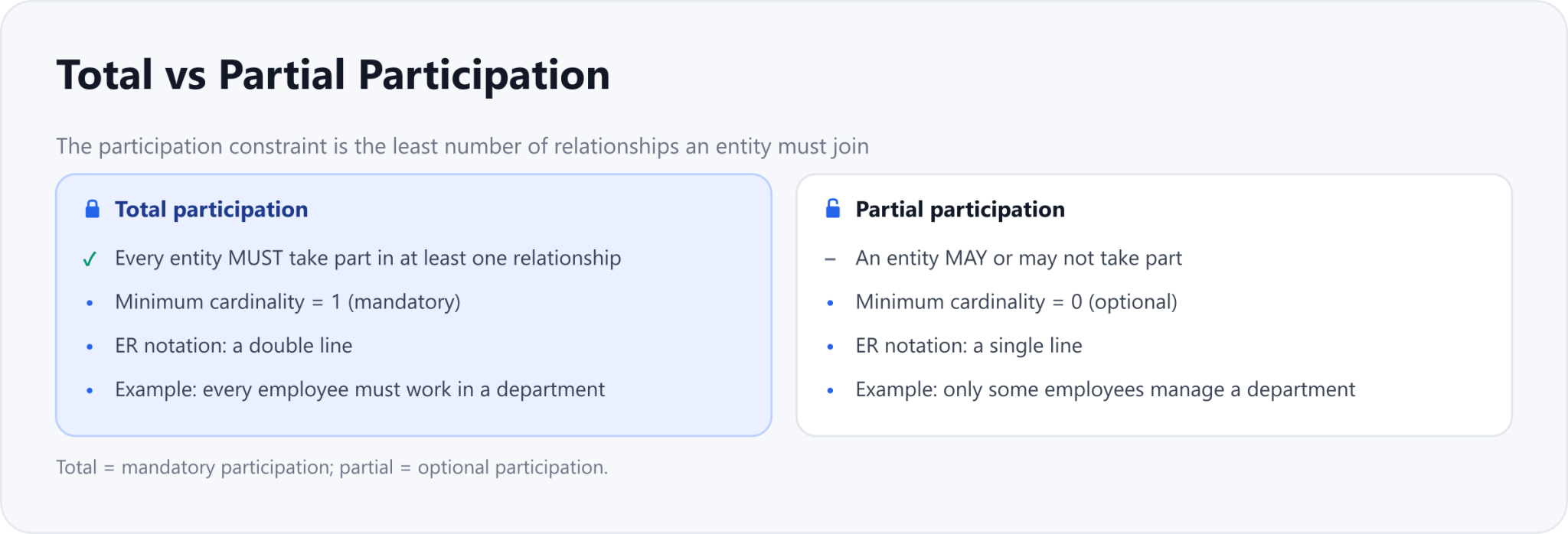
Total vs partial participation side by side.
Total = mandatory (double line); partial = optional (single line).
Specifications
Total participation: every entity must take part in at least one relationship
Partial participation: an entity may or may not take part
Minimum cardinality: 1 means total, 0 means partial
ER notation: total is a double line, partial is a single line

One relationship, two participations

Participation is defined per entity, per relationship — so the two entities in a single relationship can have different participation. Take “Employee manages Department.” Every department must have a manager, so Department has total participation. But only a few employees are managers, so Employee has partial participation. Same relationship, two different constraints.
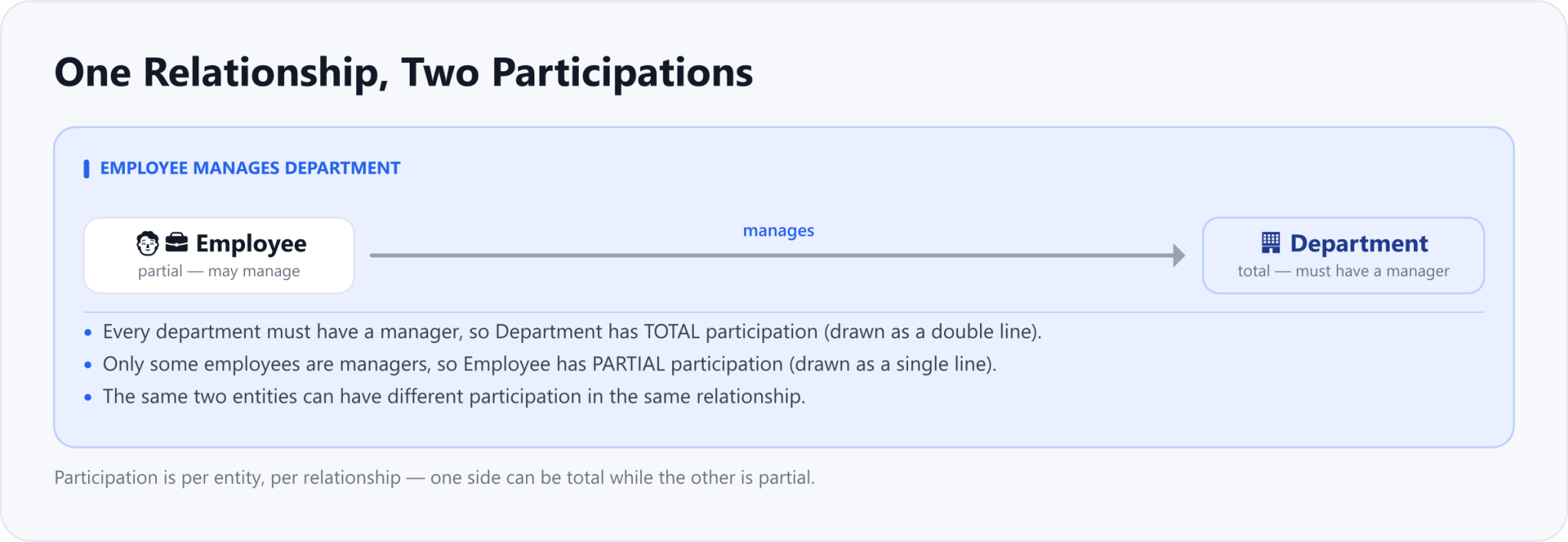
Employee (partial) manages Department (total).
One relationship can be total on one side and partial on the other.
●Employee manages Department
Employee partial
manages
Department total
  • •Every department must have a manager - total participation for Department.
  • •Only some employees are managers - partial participation for Employee.

Participation and cardinality

Participation and cardinality are two halves of the same (minimum, maximum) pair. Participation is set by the minimum cardinality: a minimum of 0 means the entity can sit out, which is partial participation; a minimum of 1 means it must join at least one relationship, which is total participation. The maximum cardinality (1 or N) is a separate thing — it sets the cardinality ratio from Part 3, not whether participation is total or partial.
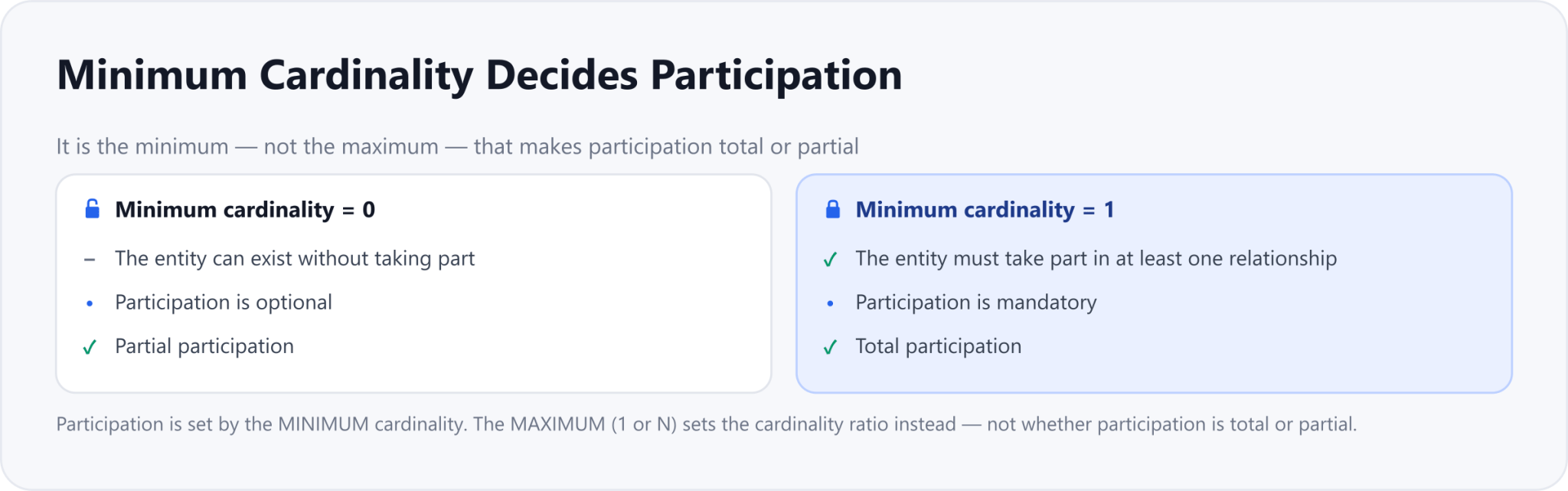
Minimum cardinality 0 is partial participation; minimum cardinality 1 is total participation.
Minimum cardinality decides participation — not the maximum.
Specifications
Minimum cardinality 0: participation optional - partial participation
Minimum cardinality 1: entity must take part - total participation
Maximum cardinality: sets the ratio 1 or N, not the participation
AspectTotal participationPartial participation
RuleEvery entity must take partAn entity may or may not take part
Minimum cardinality1 (mandatory)0 (optional)
ER notationDouble lineSingle line
ExampleEvery employee works in a departmentOnly some employees manage a department
INFO

Participation is not just notation — it drives real schema rules. Total participation usually becomes a mandatory, NOT NULL foreign key: the row simply cannot exist without the link. Partial participation lets that foreign key be NULL. Next in the series, we turn entities, relationships, cardinality, and participation into actual tables.

This article was drafted with AI assistance and reviewed by a human editor before publishing.

Share
Series: Database Management System

Part 4 — Participation Constraints in DBMS: Total vs Partial

Part 4 of 4
← Previous partPart 3 — Cardinality Constraints in DBMS: One-to-One, One-to-Many, and Many-to-Many
Latest episode in this series.

Enjoying the Database Management System series?

TechToolsHQ is an independent, reader-supported tech platform. If this article saved you time, solved a tough problem, or helped you learn a new skill, consider supporting our work. Your support helps us keep our in-depth series 100% free and updated for everyone.

100% optional · Reader supported · Independent researchSupport our work

Don't miss the next deep-dive

Weekly breakdowns of the tools students and builders actually use.

No spam·Unsubscribe any time·Privacy-first