Skip to content
TechToolsHQ
NewsReviewsGuidesTech 101Tech SeriesToolsNewsletter
TechToolsHQ

Independent, research-driven tech coverage — breaking news, in-depth reviews, buying guides, and technical tutorials to help you understand and choose with confidence.

Explore
NewsReviewsGuidesTech 101Tech SeriesFree Tools
Legal
About UsOur AuthorsContact UsPrivacy PolicyTerms of ServiceCopyright & DMCAAffiliate DisclosureEditorial PolicyAdvertise With Us

© 2026 TechToolsHQ. All rights reserved.

Tech Series/DevOps/The TCP/IP Model: How Data Really Flows on the Internet
DevOps · Part 5 of 5

The TCP/IP Model: How Data Really Flows on the Internet

The same journey as the OSI model — in the four layers the internet actually runs on.

By Himanshu Bhatt· 2 min read· September 30, 2026

The TCP/IP Model — article cover.
Key Takeaways · TL;DR
  • The OSI model is the teaching model; the TCP/IP model is what the internet actually runs on.
  • TCP/IP has 4 layers: Application, Transport, Internet, and Network Access (Link).
  • It maps onto OSI by grouping: OSI 7/6/5 become Application, and OSI 2/1 become Network Access.
  • The data flow is identical: encapsulation adds a header per layer down, decapsulation removes it up.
  • The units are the same too: data → segment (transport) → packet (internet) → bits (network access).
  • Learn both: TCP/IP for how things really work, OSI for the shared vocabulary (Layer 2, 3, 7).
☰ On this page(show)(close)
  • 1.Two models, one internet
  • 2.The 4 layers of TCP/IP
  • 3.How TCP/IP maps to OSI
  • 4.The same data flow, via TCP/IP
  • 5.The same example, four layers
  • 6.OSI vs TCP/IP: what is different
  • 7.Which one should you actually know?
On this page
  • 1.Two models, one internet
  • 2.The 4 layers of TCP/IP
  • 3.How TCP/IP maps to OSI
  • 4.The same data flow, via TCP/IP
  • 5.The same example, four layers
  • 6.OSI vs TCP/IP: what is different
  • 7.Which one should you actually know?
INFO

Part 5 of the DevOps series, and the companion to Part 4. There we followed a message across the internet using the OSI model — the teaching model with seven layers. Here we retrace the exact same journey using the TCP/IP model: the four-layer model the internet actually runs on.

Two models, one internet

Both models describe the same reality — data going down one machine’s stack, across the network, and up another’s. OSI splits that into seven layers for teaching; TCP/IP collapses it into four layers that match the protocols the internet was actually built on. Same journey, fewer boxes.

The 4 layers of TCP/IP

From the application at the top down to the wire, TCP/IP has four layers — and each maps cleanly onto one or more OSI layers.
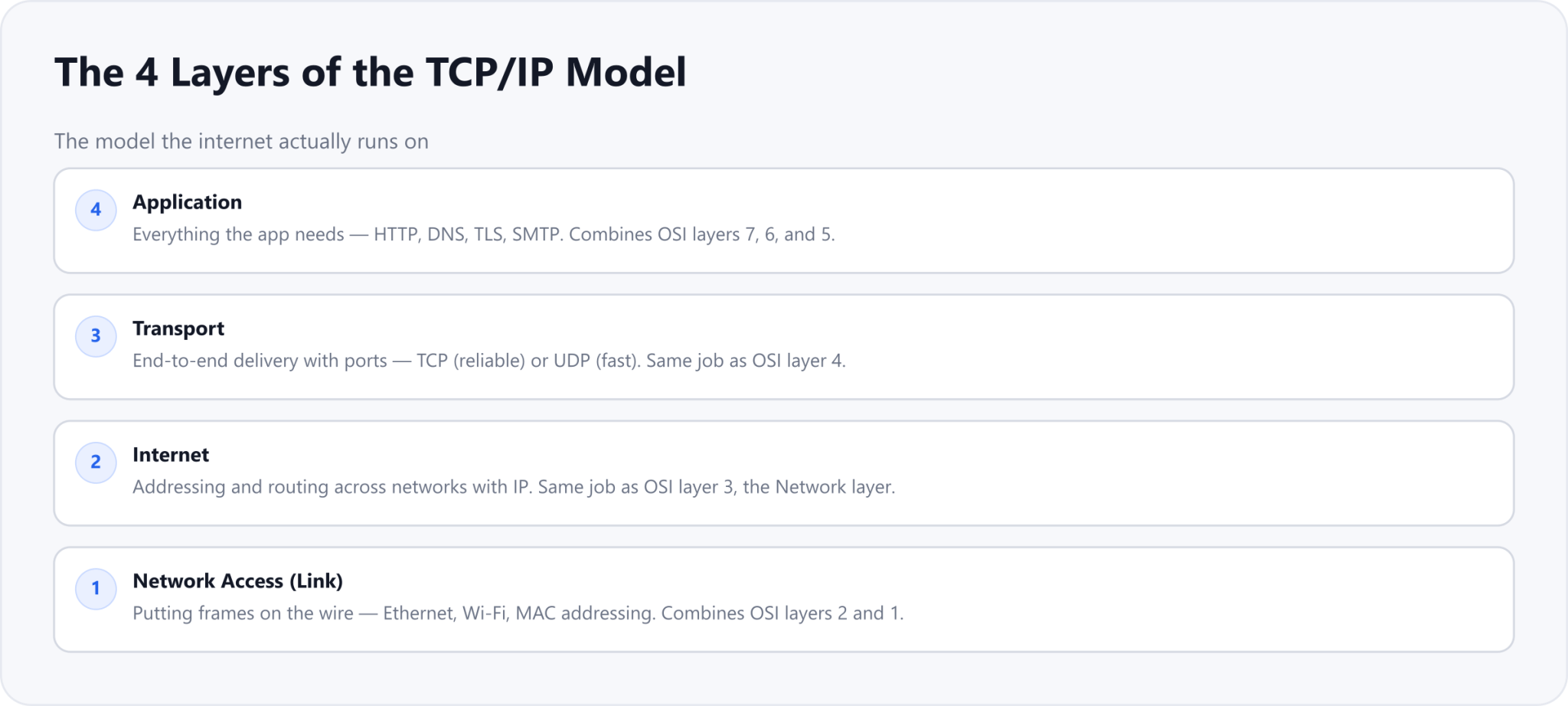
The four TCP/IP layers, top to bottom: Application (HTTP, DNS, TLS - combines OSI 7, 6, 5), Transport (TCP/UDP, ports - OSI 4), Internet (IP addressing and routing - OSI 3), and Network Access or Link (Ethernet, Wi-Fi, MAC - combines OSI 2 and 1).
The four TCP/IP layers, from the application to the network access layer.
Layer architecture
LAYER 4
Application

HTTP, DNS, TLS - OSI 7, 6, 5

LAYER 3
Transport

TCP or UDP, ports, segments

LAYER 2
Internet

IP addressing and routing, packets

LAYER 1
Network Access

Ethernet, Wi-Fi, MAC - OSI 2, 1

How TCP/IP maps to OSI

The mapping is mostly about grouping. TCP/IP folds OSI’s three upper layers (Application, Presentation, Session) into a single Application layer, and OSI’s two lowest layers (Data Link, Physical) into a single Network Access layer. The two middle layers line up one to one.

OSI model (7 layers)TCP/IP model (4 layers)
7 Application · 6 Presentation · 5 SessionApplication
4 TransportTransport
3 NetworkInternet
2 Data Link · 1 PhysicalNetwork Access (Link)

The same data flow, via TCP/IP

Encapsulation works exactly as it did in Part 4 — each layer adds its own header on the way down, and the unit is renamed at every step. There are just fewer stops.
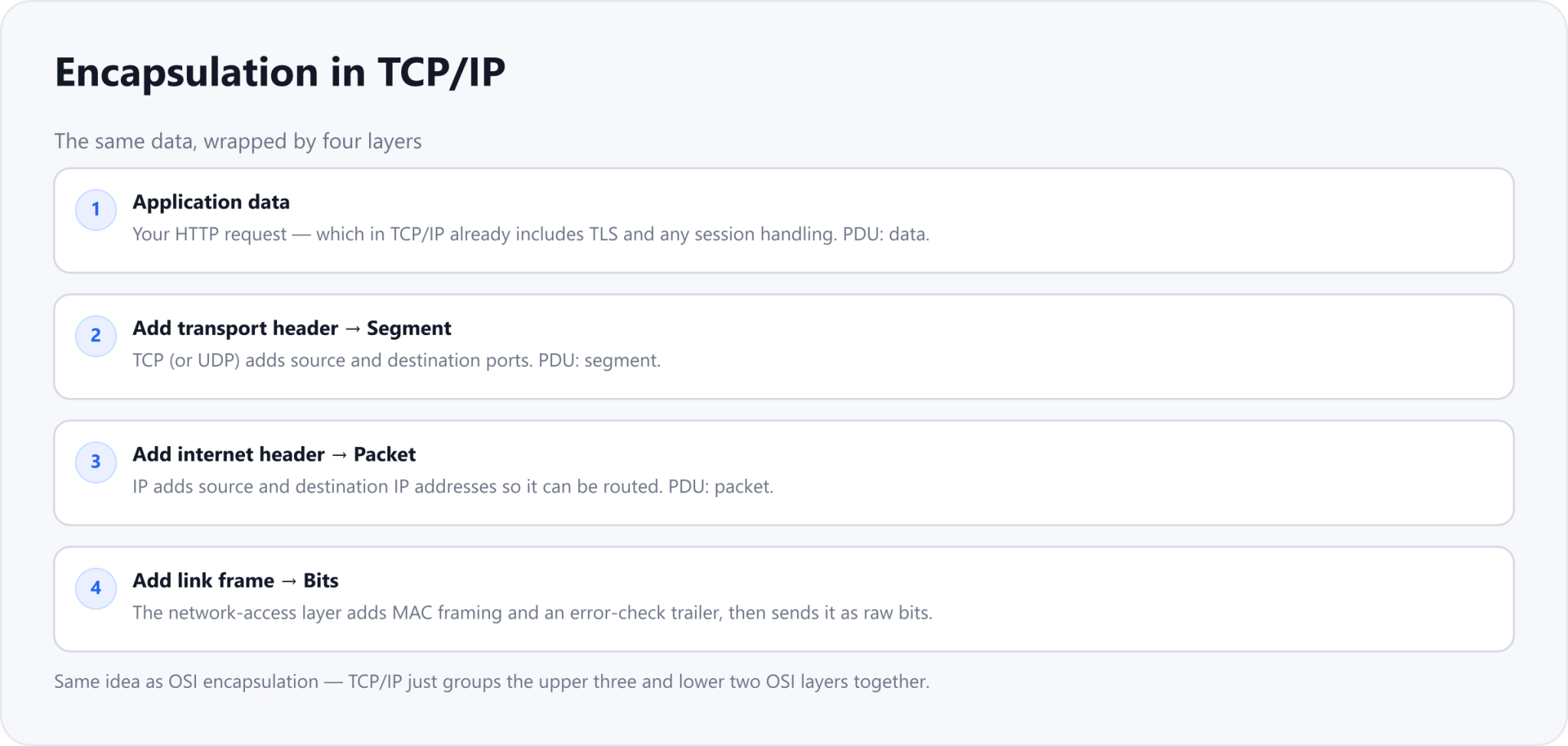
Encapsulation in TCP/IP: application data (HTTP including TLS); the transport layer adds ports to make a segment; the internet layer adds IP addresses to make a packet; the network-access layer adds MAC framing and a trailer and sends it as bits.
Encapsulation in four layers: data → segment → packet → bits.
Progressive Breakdown
Stage 1

Application data is your HTTP request, TLS included

Stage 2

Transport adds ports, making a segment

Stage 3

Internet adds IP addresses, making a packet

Stage 4

Network access adds MAC framing and sends bits

The same example, four layers

Take the same HTTPS request from Part 4 — Machine A’s browser (192.168.1.10) to Machine B’s server (13.234.56.78) — and frame it in TCP/IP. The additions are identical; only the layer names change.

TCP/IP layerWhat is added
ApplicationGET / HTTP/1.1 (over TLS)
Transport (TCP)src port 54321, dst port 443
Internet (IP)src 192.168.1.10, dst 13.234.56.78
Network Accesssrc + dst MAC + FCS, then bits

OSI vs TCP/IP: what is different

They are not competing models so much as two lenses on the same thing. The practical differences come down to how many layers each one draws and where it came from.

AspectOSITCP/IP
Layers74
PurposeTeaching / reference modelWhat the internet actually runs on
Upper layersSplit into 3 (App, Presentation, Session)Combined into one Application layer
Lower layersSplit into 2 (Data Link, Physical)Combined into one Network Access layer
OriginDefined by ISOGrew from the internet’s own protocols

Which one should you actually know?

Both, but for different reasons. TCP/IP is what your packets really travel through, so it is the model that matches tools like tcpdump, Wireshark, and your cloud provider’s networking. OSI is the shared vocabulary — when someone says "a Layer 7 load balancer" or "a Layer 3 route," they mean the OSI numbers. Know TCP/IP for how it works, and OSI for how people talk about it.

INFO

That completes the networking foundation of the DevOps series: the terms, the request journey, IP addresses and ports, and now both models for how data really moves. With this in place, the rest of DevOps — Linux, containers, orchestration, and CI/CD — sits on solid ground.

Drafted with AI assistance and edited by TechToolsHQ.

Share
Series: DevOps

Part 5 — The TCP/IP Model: How Data Really Flows on the Internet

Part 5 of 5
← Previous partPart 4 — How Data Flows Across the Internet: The OSI Model, Layer by Layer
Latest episode in this series.

Enjoying the DevOps series?

TechToolsHQ is an independent, reader-supported tech platform. If this article saved you time, solved a tough problem, or helped you learn a new skill, consider supporting our work. Your support helps us keep our in-depth series 100% free and updated for everyone.

100% optional · Reader supported · Independent researchSupport our work

Don't miss the next deep-dive

Weekly breakdowns of the tools students and builders actually use.

No spam·Unsubscribe any time·Privacy-first